research
AURA
A brain-computer interface for people who can move their eyes and almost nothing else.
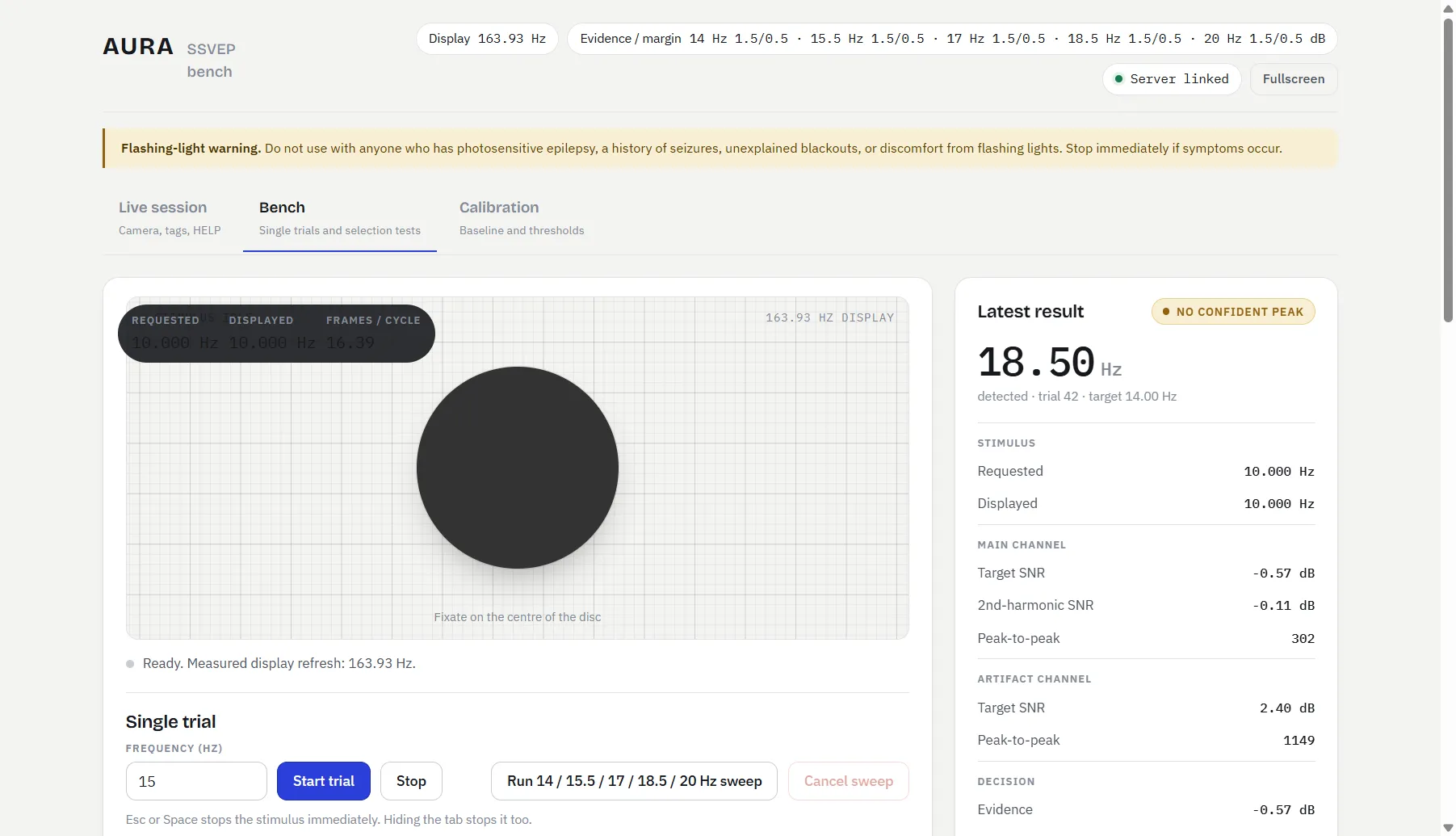
If you can move your eyes and very little else, most assistive technology is out of reach. AURA is my attempt at an interface you drive by looking.
It works on a real effect: when you look at something flickering at a fixed frequency, your visual cortex produces activity at that same frequency. Put several targets on screen at different rates, read the EEG, and whichever frequency is strongest tells you where the person is looking.
The decoder runs on the microcontroller
Two BioAmp EXG Pill front ends feed the ESP32’s own twelve-bit ADC. Sampling is 250 Hz, analysis windows are four seconds, and the entire signal chain runs on the board: a one-pole high-pass, a 50 Hz notch for Indian mains, a low-pass set at 35 rather than 30 specifically so the second harmonic of a 15 Hz target survives.
Detection is a Goertzel filter per candidate frequency rather than CCA or a filter bank. It is less sophisticated and it fits in the memory I had.
The decision rule is the part I am most pleased with. A selection commits only when two conditions hold at once: the evidence at the cued frequency clears a threshold, and its margin over the best competing frequency clears a second one. Evidence alone is not enough, because on a noisy channel something is always winning.
What the bench actually showed
I ran 206 trials across two evenings with electrodes on. 175 produced a complete record.
- 12.9 dB
- swing at 15 Hzstaring versus eyes covered, gaze alone
- 206
- trials recorded175 complete, one subject
- 38
- accepted selectionsafter contact and artifact gating
The headline number is a 12.9 dB swing: +6.82 dB looking directly at a 15 Hz disc, −6.11 dB with eyes closed and a hand over them. That is a genuine SSVEP, produced by gaze and nothing else.
The honest number is harder. Across staring trials the 15 Hz fundamental ranged from 0.11 to 6.82 dB against a 2.48 dB threshold, so it cleared roughly half the time at a four-second window. This is a working signal chain, not a working product, and I have not measured accuracy or information transfer rate on multiple subjects. I am not going to quote figures I have not earned.
Three things the bench taught me that theory did not
The alpha rhythm was cheating. With a 10 Hz and 15 Hz pair, 10 Hz won twelve of fourteen trials regardless of what was on screen — including two trials where the stimulus was at 41 Hz and the low-pass had removed it entirely. The brain’s idle rhythm sits at 10 Hz and it was drowning the stimulus. The fix was to move the whole command set off alpha, to 15, 17 and 19 Hz, and subtract a measured resting baseline per frequency.
Longer windows made it worse. I assumed eight seconds would beat four by simple averaging. It did the opposite: evidence fell from a 0.11–6.82 dB range to −6.13 to +1.78 dB. Fixation drift and SSVEP adaptation beat the square-root averaging gain. Four seconds stayed.
Dry electrodes do not work here. Without gel, occipital contact railed the amplifier between 0 and 4095 with hundreds of clipped samples per window. With gel and no other change, it settled to a peak-to-peak of 37–95 and zero clipping.
The layer on top
A camera and a vision model look at the room, identify objects, and render a flickering tag anchored to each one. Selecting an object then produces a fresh set of candidate intents, which become the next set of targets. In practice it means the interface is generated from whatever is actually in front of the person, rather than a fixed menu.
Bed and wheelchair actuation are displayed and logged only. Nothing physically moves, and I would rather say that than let a demo imply otherwise.
Status
This is a final-year project with a patent filing in progress, so this page describes the system rather than the claim. What is built: the full signal chain, contact and artifact gating, guided calibration, the vision layer, the live session with permanent help and cancel targets, and the operator interface above. What is not: alerting that survives losing the network, which is the most serious limitation it currently has.